Showing posts with label Germany. Show all posts

Thursday, February 21, 2013

Outsider


It’s a shame I don’t drink more Riesling. 

In some aspects Riesling appeals far more to me than Chardonnay does (without bubbles). If to rudely generalize; Riesling are an ultra clear non-oaky expression, strong terroir defined wines with the high acidity (which I am a sucker for). If to stay on the generalizing string, that is far more interesting than the somewhat monotone melon, oaky and oily expression of Chardonnay. That’s why I never found true love for white Burgundy, but my compromise eventually founds its way into Champagne. That said – during my journey into natural wine country, I have found lots of wines, which deviates from this generalizing description and made me happy.

My appetite for Riesling has dropped dramatically since this Champagne and natural wine bug started. The German Riesling are not exactly known for their low sulphur levels, yet I can’t say that I have had many experience where the wines actually stinks of SO2. So what's the fuzz? In most cases with German Riesling, they are simply too square and lifeless for my palate. Their structure are too polished/ “slippery”, taking energy down and headache up, which in most cases are sings of too high sulphur. And if you are a sucker for energy (like me) it’s not a relationship that will last.

Having said that and before this develops into a “polish-my-own-halo-post” - If you haven’t been exposed to a lot of natural wine, I am not sure you see it this way. My good friend Martin from Berlin, whom I consider be a very skilled taster and an expert in Riesling for sure doesn’t see it this way. It’s important for me to stress out that my taste is not the right one – it never is – but my starting point is very different, because I drink so many low dozed SO2 wines.

Anyway a German Riesling without SO2 – sounds like paradise to me. The paradox is that the wine is categorized as a “Landwein der Mosel” because the local authorities don’t approve wines of this low SO2. Who cares about appellations snobbism, let’s jump onboard.


2011 Rita & Rudolf Trossen, Riesling “Schieferstern Zero Zero”

Blend: 100% Riesling
Terroir: Slate
Winemaking: Biodynamic
Alcohol: 12,05%
pH: 3:15
Free SO2: 0 mg / l
Total SO2: 1 mg / l
Production: 400 bottles
Glass: Zalto Universal

Trossen have been experimenting with zero SO2 since 2009 but at first had doubt’s it could be successful. Tasting the zero sulphur wines from Jura & Burgundy finally convinced Rudolf Trossen and in 2010 he released his first non-SO2 wine with the 2010 "cuvée Pyramide PUR". Only 15L was made.

As you can see from the image there is a capsule on the bottle and still some carbon dioxide left. Give it some air and it’s gone after 30 minutes or so.

I was struck by the crystalline clarity of this wine. Ultra refined fresh water appeal, like drinking directly from the mouth of a water well. Notes like tulips, citrus, greenish apples and freshly washed linens in cool spring air emerged and all together shapes an extraordinary elegant and pure wine. The taste is utterly sensational, despite being really young  - mineral extravaganza with a vibrant, frisky and agile acidity. Nothing sticks out – everything is so beautiful toned creating blissful harmony. What a wine – what a Riesling. Absolutely stunning wine.

Ps. My wife who knows absolutely nothing about wine (I have given up), but in general hates oaky white wines (she calls them unnatural) – thought this wine was one of the best white wines she had ever tasted.

Thank you Ine & Ries for this bottle – you are too kind.

Tuesday, May 15, 2012

Recently tasted wines


Many of these wines are tasted either at home or in the company of good friends without any notes taken.

Champagne

3 Champagnes tasted in London with my friend, Anders.

2006 Georges Laval “Les Hautes-Chévres”

They say Vincent Laval have made his best vintage ever in 2006. Now, that would be impossible for me to judge, as I am somewhat of a novice when it comes to Laval. But my God what a Champagne I was about to taste. Mind-blowing complexity with a deep scented Pinot Noir frame, holding slightly overripe fruits and yet it has such a sleek presentation driven by a mineral overload. A very young Champagne, but with such vitality ,who can keep hands of now?


2006 Larmandier-Bernier “Vieille-Vignes de Cramant blanc de Blancs”

Hard to follow Laval’s quality and I needed a few minutes to level with this Champagne, which of course is a different grape and terroir. It’s not as deep as Laval (few are), but this is beautiful Champagne, holding creamy sensations of milk skin, banana and pastry. Cristal clear taste with good mineral bite.

2006 Georges Laval “Les Meuniers de la butte”

Fell rather lucky getting the pleasure of tasting this rare release once again. This bottle was slightly more reserved compared with my previous experience in Dec-2011. Still a one of a kind and the most exotic Pinot Meunier I know of.

At home again:

NV Laherte “Les Clos"

My last “Les Clos” in June-2011 was the first disappointment ever and I have been eager to erase that experience ever since. It happened a weekend in March-2012, were this Champagne once again won my heart. I loved it – find it absolutely stunning with sizzling fresh appeal of both greenish fruits, citrus overload, sophisticated spices (like black tea) and a great acidity game. I believe this bottle was disgorged in early 2010.


2004 Georges Laval “Cumiéres Brut Nature” from Magnum

Served for lunch at my wife’s birthday. Everyone around the table loved it – including me. Just plain a simple adorable with solid baseline of spicy scented fruit, matched up with citrus sparkling and vibrant mineral bite.


2006 Christophe Mignon “Millésimée”

First time I taste Champagne from this producer.  This cuvée is based on 100% Pinot Meunier. A Rich Champagne, with honey fruits, brioche, flowers and some caramel associations. There is deep baseline of dark phrasings, spice-window adding to its density and rich appeal. Despite such bold a character it’s also holds decent purity and a very vibrant acidity keeping everything in balance. I found it   very pleasing to drink. Very interesting new Champagne discovery.


NV (2007) TH & V Demarne-Frison “Goustan”

Another pleasurable reunion – yet it’s evolving a bit faster than anticipated. A Champagne born with really splendid sensorial sweetness, despite the absence of dosage. It’s now accompanied with deeper honey flavours and even some brioche notes, taking the seductive appeal higher. The acidity is still firm, but I believe it will have it’s peak now + 4years.

2009 Cédric Bouchard “Les Ursules”

It’s a shame I didn’t shoot an image of the colour on this Champagne. The 2009 have an incredible dark glowing colour and it’s a beautiful treat for the eye. The inside of the bottle is not bad either, yet I would like to cellar it some two years more before I try it again. It shows how compact and well build Les Ursules are. You can already tell the material is there – however it’s not unfolding yet and the dark cherry notes create too much bitter components for the moment. I am confident it will be better to wait.

2006 Bérèche “Instant Rosé No.1”

I have always loved this Champagne, but when I bought my six-pack just after its’ release I had no idea it would become a cult Champagne - and Raphaël’s best Champagne. It’s been a year since I last tasted it (April-2011 @ Terre et vins de Champage from Magnum)  and it has gained even more intensity. For me it’s a textbook rosé Champagne with salty red perfumes of strawberry and apricot. There is a bit more smoke providing a deeper spectrum and a solid intense baseline. It never get’s too much and it’s so focused and complex.  Also a Champagne ,which you can easily raise up to 16 degrees in temperature without it loosing nerve and focus.  Absolutely adorable Champagne. Disgorged 4th of May 2009.


Whites:

Mostly tasted Alexandre Jouveaux and my favourites “Chez Charles” and “Selves”. But I did also have a Riesling:

2005 Müller-Catoir Riesling “Breumel in den Mauern” Grosses Gewächs

Extremely bold Riesling opening without any kind of focus and pleasure. In the glass I had an opulent and alcoholic Riesling. It gave away a lot of unfriendly spice scents – sadly leading to reductive tones and in the end giving away some sulphur resemblance. I couldn’t continue the journey and rested it for another day. Day two and three it was still horrible, but at day four some signs of improvement came forward - with a bit more clarity setting in. I liked the structure more than the bouquet itself, but overall it never became a successful date. Maybe it’s in need of further cellaring?

Reds:

2001 Fontodi Flaccianello della Pieve

Highly sensual and seductive Italian Sangiovese wine, with a mouth coating appeal. It starts with eat-me-tiger notes of vanilla, leather and dark cherries – all wrapped up in a tense and velvet styled finish. As you pour yourself one glass after another the wine becomes more and more monotone as main attraction is not complex notes, but a wine masked by a way too high  level of new oak. That said – it’s not a wine that is hard to drink – it’s just a wine that doesn’t tell a story.  


2008 Julien Courtois “100%”

I told the retailer that I was looking for a wine with higher purity and preferably fragile red fruit. “Here is one I think you will like, but it’s not a wine with fragile red fruit”, he said.

First impression was something like “hmmmmm”…yes for sure not that fragile red fruit I am always hunting for – but instead dark luxurious fruits. The wine has certain sensuality, flowing with blackberries, dark cherries, forest floor and a sophisticated note of celery. The taste is incredible fresh, juicy, silky and best of all really light weighted. Very delicious.

Friday, June 10, 2011

What else April & May 2011

All images are clickable and will open a larger format.

April and May has of course offered a good deal of Champagne due to Terre et vins de Champagne. But it’s also the coming of spring and now slowly summer, which adds even more Champagne and white wines. This is logical for most of us, but I recently noticed, while attending a tasting with US-reds, that I am increasingly very negative biased towards wine with strong alcohol profiles.

I have to be realistic about this and it seems kind of ridiculous to use this site to bash one after another of these types of wines. I simply don’t understand these wines anymore and should you be of another opinion you should probably look elsewhere for advice. Below are the wines I tasted during a US-tasting, which my very good friend Anders hosted. It should be noted; that I have tasted a fair amount of SQN wines and among those listed the SQN wines once again offered some sort of edge and allure, despite a violent strong and dense fruit core. I have even listed some Italian wines, which I also had a very hard time with. I don’t know if it’s appropriate to say that I feel worried, but thing is, I am getting more and more picky and wines that I use to love are now giving me a very hard time do a degree where I simply can’t drink them.

2004 Merryvale “Profile”, Napa Valley (Cabernet Sauvignon blend)
2005 Darioush “Signature” Cabernet Sauvignon
2007 Chappellet “Pritchard Hill” /Cabernet Sauvignon, St Helena, Napa)
2004 Agartha (Syrah + a tiny bit of Grenache, marsanne, viognier & rousanne)
2006 Sine Qua Non – Raven, Santa Barbara, (syrah)
2007 Sine Qua Non Labels, Santa Barbara (syrah)
2006 Saxum Heartstone Vineyard, Passo Robles (Grenache, syrah og Mouverdre)
2008 K Vintners - The Creator (Cabernet og Syrah), Walle Walle, Washington
2008 K Vintners - Roma en Chamberlin (Cabernet & Syrah) Walle Walle, Washington
2008 K Vintners - The Deal (syrah) Walle Walle, Washington
2008 Gaja – Sito Moresco (nebiolo, barbera og CS)
2007 Gaja - Barbaresco (Nebiolo)
2001 Gaja Conteisa
2000 Gaja Sorí Tildin
2001 P. Scavino Barolo, “Bric del Fiasc”

(2004 L'Artiste)

But let’s focus on some of the interesting wines I have tasted – especially my Champagne encounters have been magnificent.

Champagnes:

2005 Vilmart “Grand cellier d’or”

Blend: 80% Chardonnay, 20% Pinot Noir
Dosage: Not sure – but the 2004 vintage was dosed with 9 g/l

It’s not always right to compare….I think I have said that right? Sometimes the diversity is more interesting. Well….let’s see if I can navigate through my own rules, because this is a tricky one. You see, this wine was a starter to what lead to a rather crazy night where 4 happy people shared a good deal of Champagnes. Anyway….a good starter which secured instant pleasure with it’s rather seductive nose of vanilla, walnuts and spices. However, when the next wine was poured it collapsed in comparison. Suddenly it was too sweet and almost vulgar. Still let’s remember it for really fair laid-back drinking Champagne. So what was the next wine?....well…read the next tasting note.

2004 David Léclapart “L’Artiste”

Blend: 100% Chardonnay
Disgorged: Aug-2007
Dosage: 0 g/l dosage
Other: L’Artiste is made from 30-50 year old wines and ages half in steel and barrel

Since the bell rang for an open window on the ’04 “L’Artiste” I have had it 3 times and I sense that I will soon have drunk them all. This Champagne is simply mind-blowing stuff. It’s like a razor blade of minerals and it’s enters with so much soil energy and purity that you are completely blown away. It’s like a crystallized bath of seashells, baby banana and green apples. There is not much else to say about this Champagne – it’s a small masterpiece.

(2002 David Léclapart “L’Apôtre”)

Blend: 100% Chardonnay
Disgorged: April-2006
Dosage: 0 g/l dosage
Other: L’Apôtre is a lieu-dit of La Pierre St-Martin with vines planted in 1946 and made only in oak.

It’s been a while since I have had the 2002 “L’Apôtre” and I consider most 2002’s out there rather closed. Still I took a change to open it and sadly it’s very shy and not all there yet, far from it. Still, I think there is some interesting information here. I remember asking David about the cellar potential of “L’Apôtre” and now begin to see that his guess of 25-35 years is more than likely. This Champagne is poised with soil almost wet rocks of soil energy and the raw side of it, is like taking a bite of the nature. I adore it for it’s style, but I have to remain patient, which is always a challenge for me.

(The neck of Billcart-Salmon)

1996 Billecart-Salmon “BdB”

Blend: 100% Chardonnay

Damn!!!...It’s not there yet. Still very shy and it’s like the fruit is covered with a fine film of milk. It has some flowery stuff and sweet vanilla pastry thing going on, but really not more than that. I have to recommend another 5 years of cellaring.

Jacque Selosse “Rosé” (twice – but different disgorgement dates)

I have had this twice and the “normal bottle” – disgorged 2nd of February 2009 is with 7 g/l dosage and performed like it always does. It still fells like a big teddy bear – a real seductive breed, which I like, when I have it in companionship with food and friends (You can read a more detailed note here). The second bottle is the latest release and it’s disgorged the 26th of November 2010 and has only 2 g/l of dosage. The wines feels much more fragile now, if you can say that about Selosse. It’s saltier, slimmer and despite the flavours is still turning towards strawberry, apricot and Asian spices; it has so much better balance. It almost feels like the Champagne isn’t blended with so much red wine, but that is just an assumption from my side. Anyway it’s the best Selosse rosé I have tasted.

(1999 Selosse Vintage)

1999 Selosse Vintage

Blend: 100% Chardonnay
Disgorged 9th of January 2009
Dosage: I am not sure, but think its non-dosage
Bonus: Zero Sulfur

Can you ask for more? Well maybe, but if we stay in Selosse own universe, this is close to perfection. Despite having tasted it twice, this is by far the most impressive ’99 I have had. It’s a volcano of Selosse with quince, clove, honey and evening perfume. These notes are normal for Selosse and the taste is also a full-blown dense, waxy – almost creamy mouth feel. A Champagne of such a profile could easily fall into a category of vulgarity, but it’s poised with an enormous energy, which drives this powerhouse of a Champagne into a seamless presentation. WOW!!!!!!!

(Contraste)

NV Selosse “Contraste”

Blend: 100% Pinot Noir
Vintages: 2002 + 2003
Disgorged: 4th of February 2009

Maybe one of the final releases of Contraste, as the back label already gives information about the upcoming split of the two vineyards in Aÿ and Ambonnay from 2004 vintage and forward. So maybe a bit sentimental or just the fact that I was sharing this bottle with Champagne loving friends, because it turned out to be the finest Contraste I had ever tasted. The notes are typical Selosse or maybe we should say typical Contraste, because it’s deep and sensual Pinot Noir, which flirts with walnuts in layers of honey. The most adorable aroma was however the note of orange blossoms which took the complexity and seductive appeal into a heavenly stage. I think I have one single bottle of Contraste left in my cellar – I cross my fingers it’s from the same disgorgement date. Magical.

(Old Krug Rosé)

NV Krug “Rosé”

(Disgorged 1980)

Don’t ask me how I know it’s disgorged in 1980 – I don’t. My friend, who brought this bottle just, said it and the information might have been on the cork, because I couldn’t find anything on the bottle. Anyway – it makes good sense that it’s a really old bottle. It’s just on the verge of tilting over – fruit wise that is. However the funky tertiary aromas and a really vivid acidity had the ability to crank up the complexity and despite some emerging mould aromas on the nose, I overall really liked it.

('08 Prévost)

2008 Jérôme Prévost La Closerie “Les Béguines”

Blend: 100% Pinot Meunier
Dosage: 0 g/l

Being served after Selosse (The 1999 vintage) is never funny. But! Someone has to do it and I chose a former student of him; Jérôme Prévost. This is the second time I have this promising 2008 vintage and I think you have to pinch yourself in arm when having this – it’s that good my friends. These spices are so sophisticated and they take shape of aromas, which are so complex and impossible to fit into normality. You can detect some black cherries and a wicked note of licorice, but it’s so subtle and refined. The taste is still very tight, but you already have this remarkable sleek texture. It will be interesting to follow this ’08, but I think we have potentially the best Les Béguines here (so far that is).

2004 Bérèche Instant "Le Cran" Vintage

Blend: 55% Chardonnay, 35% Pinot Noir, 10% Pinot Meunier
Dosage: 4 g/l??

I am not sure about the dosage in this bottle, as it was a sample, not the official release. However I suspect 4 g/l, like the official release of this Champagne.

Raphäel have really lifted his Champagnes into a level of weightlessness and lush fruit appeal, which brings them lots of allure. However, I have had my concerns about this Champagne – especially it’s level of vanilla from the oak as it joins forces with this level of dosage. However it’s like the balance point are correct and it’s typical Bérèche with adorable notes of apples, pineapple and baby banana.

(2004 "Le Chênes")

2004 George Laval “Le Chênes”

Blend: 100% Chardonnay
Dosage: 0 g/l
Disgorged: 20th of February 2009

On Paper I shouldn’t have served this Champagne, as we already had too much to drink. However I am glad I did it, because we only drank 3 glasses so there was a good excuse for me to have some more Champagne the day after.

It’s an unbelievable Champagne with an orgy of passion fruits; mango, kiwi and overripe peaches. I have sometimes found the overripe element too much in Laval’s wines, as they get anchored with biodynamic notes of wet hay. But I have to admit he is a producer I have to pay more attention to. In this 2004 there is nothing overripe despite these notes are heading towards this passion fruit thing. This Champagne completely took me by surprise by showing such remarkable class and sleek elegance. It’s seriously one of the most exquisite 2004’s I have tasted.

2002 Bollinger “La Grande Année Rosé”

Blend: 62% Pinot Noir (6% red wine from a parcel in Aÿ ) and 38% Chardonnay.
Dosage: About 8 g/l

After having spent a day with Cédric Bouchard, Benoît Tarlant and a quick stop @ Bérèche our last stop on this trip to Champagne was l'Assiette Champenoise, where we both stayed and had dinner at their ** Michelin restaurant. The food was rather good and probably the best place I have tried in Champagne. I missed a larger selection of grower Champagne on the rather expensive wine list, but it’s slowly coming I am being told. After so much grower Champagne I thought it could be fun to taste something from a big house producer and I was rather happy about my choice. Despite it’s holding a bit back (again a reserved 2002) it’s a solid good GA rosé. It’s classic Bollinger in terms of a sound concentrated style with deeper layers of red fruit. However Bollinger balances it out great with lighter breezes of flowery perfumes. At this stage I found the purity and definition lacking a bit behind in terms of what I had just tasted that day, but still it has lots of time ahead of it to stretch itself and gain more complexity.

Other Champagnes

There is seldom a month without my daily drinkers, which in most cases are Laherte “Brut Nature”, Laherte 2006 "Vigne d'Autrefois" (Much better on day 2…so cellar 2 years more), Tarlant Brut Zero (normal and Rosé….see a small video here) and the latest Benoît Lahaye Brut Nature (2008 base). All great and some enjoyed over 3 days and still showing remarkable freshness and delicious drinkability.

Whites:

2007 Fanny Sabre “Mersault Charmes”

Mersault is known to be fat, oily and buttery and if you kick in a good deal of oak you get a combo, which I not always a fan of. But in the hands of Fanny Sabre – a woman (maybe that’s it), you suddenly have a Mersault, which is shining with remarkable clarity and poised elegance. Sure you have some buttery components, but it’s more in the line of toasted bread and some smoky subtle sensations. There are additional fruits from melon and apples, which has companionship of straw and hay and all in all it’s adding to the complexity of the wine. The taste is fine vertical line with ends in a slim vivid finale. Loved it.

2009 Julien Altaber “Bourgogne”

I don’t have much information about this producer, which is completely new to me. Apparently there is a link to Derain and him. He has worked there, but if he still does it – I don’t know? First impression from the nose what nothing more than a simple table wine. Notes of melon, smoke, flowers, citrus and straw and a taste, which ends far too warm with a dull, polished structure. At this level – only it’s purity it worth mentioning, as it falls into yet another rather boring “Chardonnay”. However!...It took a turn, after an hour or so and really firmed up and became far more delicate and it’s purity was penetrating trough the layers and suddenly it wasn’t just another Chardonnay. Sadly it didn’t loose its polished structure, which prevented a real acidity smack. Still an okay wine and very fair priced.

Dönnhoff

2004 Riesling Spätlese “Hermannshöhle”, Nahe, Germany

Lovely – light, fresh with honey and peach. Taste is very vertical and it’s drinking so well.

2006 Riesling GG “Hermannshöhle”, Nahe, Germany

Very strange wine. Blends in some botrytis, yet it also has a raw side with this fennel thing on the nose. It ends in a combination of snaps and acacia honey. Not good – even on day 2 and 3 it was still completely out of focus.

2005 Riesling Auslese “Hermannshöhle”, Nahe, Germany (0,375cl bottle – tasted twice)

First time in late April it was served in Zalto Universal and here it performed the best. It’s seriously one of the best and most exquisite dessert wines I have had in a while. So lush, ripe, and intense - yet so ballerina light. Amazing drinkable stuff.

(Like that label and the wine is good too)

Reds:

2009 Vini Viti Vinci “Irancy”, Burgundy, France (100% Pinot Noir)

Well – looking at the label and tasting the wine got me in a good mood. The wine has a lovely instant and juicy red fruit appeal. Drinking incredible well at this stage and it could easily be one of those few reds I could consider drinking this summer.

2001 Poggio di Sotto “Il Decennale”, Tuscaly, Italy

This wine was dismissed by the DOGC as a Brunello di Montalcino due to a too light colour. Well, since the big fuss when it was released, it has actually gained some of its colour back. Brunello or not – it’s a beautiful wine, with a good deal of red fruit, refined spices and it’s a wine I loved for it’s tallness and delightful and intellectual style. Taste is solid Italian with clean, refreshing and fine tuned matching concentration to the package. Just a notch below Soldera’s Case Basse, but a great wine, with lots of cellar potential. Decanting is however required at this stage.

That’s what I remember….this might be the last post before the summer break, but I have a big Champagne tasting coming up tomorrow, so let’s see how much time I get.

Saturday, March 12, 2011

2005 Dönnhoff Riesling Spätlese "Schloßböckelheimer Kupfergrube"

100% Riesling – but of course.
Decanted 2 hours and tasted over 3 days.
Glass: Zalto Universal

In my sad wine life I had a window - where I stocked up in German Spätlese. That obsession ended abrupt and became Champagne.

But returning to Spätlese land reminds me how incredible delicious they are. However the sweetness is tricky for me to handle. You can bend the wine in any shape you can think of, but it will always circle around some degree of residual sugar. This is becoming a dilemma for me, as I tend to favour dryer wines - both Riesling and Champagne for that matter. Why? For many reasons, but one main factor is to fully feel all the soil components, where the sweetness can acts as a small membrane and takes you a few meters away from the action.

These Spätlese are even so low in alcohol, so you can flush a bottle down, like it was lemonade and not really pay much attention what you where drinking. So we are dealing with a wine, which is on one hand captures; pure laid back drinking, but on the other hand the sweetness is taking it some notches down in complexity. Well at least for my palate.

So I thought and so I assumed. The Spätlese category was nailed. Been there, done that. Then this wine comes along and I guess the wine-gods, or maybe it was Herr. Helmut Dönnhoff, which had other plans for me. Fact is, after having drunk this wine over 3 days, I realized that taking notice of some of the worlds most subtle wines, is not a lap dance, it actually requires training and you as a taster to focus and level with the wine. Do that and I promise you, magic appears.

This wine has unbelievable clarity and so many delicious flavours. It’s like the sun on a crisp spring day, with mild winds and bird singing (I am such a romantic). There is still a lot of baby fat on day 1, but it’s always a secondary indicator, as the fruit has such lush, subtle and vivid electricity. Notes may sound like so many other spätlese; honey, peach, lemon, pineapple and small fractions of petrol notes - but it’s underneath brushings of soil components, which gives so much backbone and tallness. Taste is nerve wrecking nice, with laser sharp acidity, crystallized minerals and the sweetness is like turbo boosters, which spins the aromas and quadruples them – not in flavours, but in electricity. The aftertaste is so overwhelming, but yet so weightless.

It feels like the wine wants’ to let you know; “less is always more”.

Sensational wine, Bravo.

Tuesday, August 24, 2010

3 X German Riesling – short notes

(Yes sorry - the flowers again - I am running out of ideas ;-) )

I had the 2007 Riesling GG ”Halenberg” from Emrich-Schönleber on a beautiful July summer day. I found it very mouth coating and generous with honey fruit, but not particular complex, as the fruit core was too oily and elastic, which took some grip away. I didn’t decant it and I am sure this was a mistake. Have a few more – but might cellar now in order to bring out more layers.

I found the 2004 “Hermannshöhle GG” from Dönnhoff much better. This wine is sensational delicious – with notes of lush peach and mango. Some of my most geeky Riesling friends find Dönnhoff too polished and I can see what they mean, but with a wine like this, you just have to surrender yourself.

The last German Riesling I had was the 2005 Schlossberg from George Breuer. The wine was very disappointing with strong notes of honey, fennel, hay, ginger and gasoline. I consider Breuer to be an excellent producer and am particular fond of the “Nonnenberg” – but this wine was really awkward. I e-mailed my good friend Martin, who I trust as a true Riesling expert and he told me that Schlossberg is a wine to cellar and not drink now. So there you go – don’t listen to me.

Cheers…and all in Zalto Universal – the glass on the first image.

Tuesday, June 8, 2010

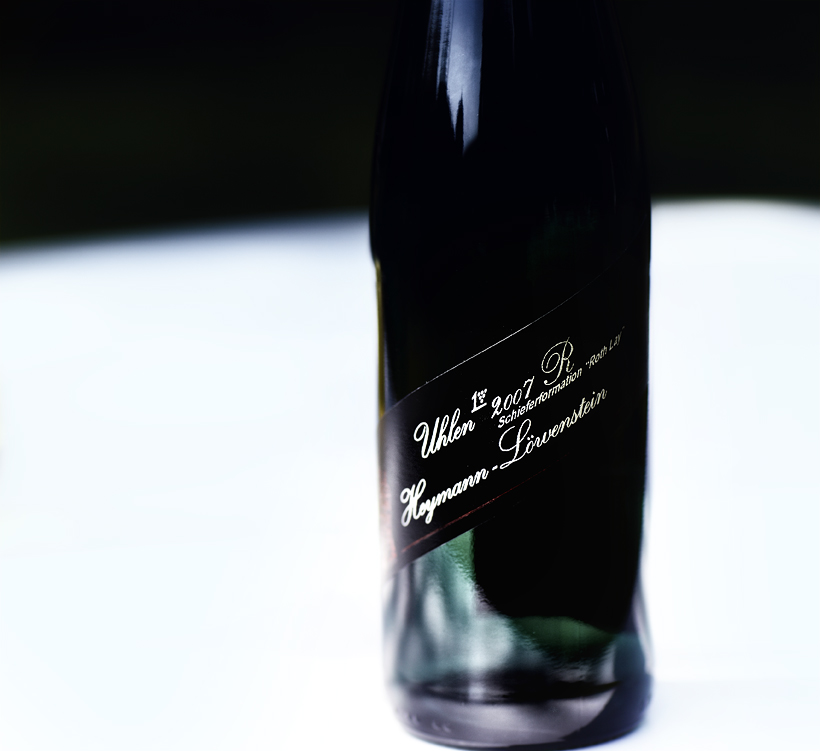
2007 Heymann-Löwenstein,"Uhlen Rothlay", Germany

Decanted 8 hours
Glass: Zalto Universal

Heymann-Löwenstein makes incredible wines and the “Uhlen Rothlay” is one of my favourite Rieslings.

To some degree this wine is too much. It leans towards a way too dense/oily style, with an overripe note of peach, acacia honey, which almost takes the shape and feel of caramel. On top of this, Rothlay is a spicy wine; white pepper and slate notes, which aren't exactly "friendly". This is the main reason why I always decant this wine so long - to sort of temper the beast and creative a better balance. It has worked with great success in the past. With this 2007, I almost feel I should have given it another 3-4 hours. Having said that - and listed all of the components and basically already concluded that the wine is too far from what I look for in a great Riesling - I still love it. Confused?

Well. When I wrote the Krug Party notes, I knew I was going to use a description over and over again. The description, or note if you prefer, was energy. Energy has evolved into an obsession for me. It's something which is hard to explain on paper and not something I can always measure, and it can affect everything from the wines freshness, to it's structure, viscosity, acidity and how complexity is not only defined in layers, but also how much edge each layer has.

This wine has tons of energy and - despite its violent style - it creates a second dimension, which allows you - as a taster - to get closer to the wine and feel how genuine a wine you have in front of you.

The 2007 Uhlen-Rothlay is impressive stuff, however not in the same league as the ‘2005....but maybe it will come…8 hours of decanting didn’t tame this unique wine…one should remain humble about concluding. Time will tell.

Monday, August 10, 2009

2005 Heymann-Löwenstein, Riesling "Uhlen-Rotlay"

The worlds best this and that….something that I rarely defines and find interesting.

But!!!!

This has to be one of the finest Rieslings there is on Planet Earth and it’s really interesting that I have that feeling towards this wine, as my palate turns into the graceful and elegant side of wine. To understand this wine fully and what I am rambling about, you HAVE to decant it with a minimum of 7-8 hours (A year ago I gave it 12 hours). Before the colony of “No-no-decanting-so-long” comes rushing to whip me, I know there is a risk involved by such a provocation of air. “Rothlay” (it related to the soil, which is slate with a dark red color) is a spicy wine and it’s texture leans to the oily side (FAS: 2 I think). Decanting will take away the spicy tone a few notches down. But what I find interesting is that it brings out the ability to look beyond this sometimes overwhelming opulent spicy nose and see the linearity that this wine holds. It also takes the oiliness away, which for me it to be avoided if to see magic. The spices (white pepper, warm slate, salt and herbs) will always be there on the tongue and more importantly this nicely warmth of the back palate. But what I like most (and I have mentioned this before) is the incredible energy this wine has. It reminds me a lot of “Apôtre” from David Léclapart and in recent time, this life and energy headline has become an obsession to me. What a beauty, I enjoyed every drop with overwhelming pleasure.

Glass: Zalto Universal

Thursday, July 30, 2009

2004 Keller Riesling GG "Hubacker", Germany


Couldn’t find a picture – so with the courtesy from Martin Barz – here is his picture of the wine label.

I don’t think I have tasted a 2004 German Riesling that I didn’t like and even in Champagne I find the 2004’s I have tasted incredible appealing. 2004 “Hubacker” is really mouth coating, dynamic and a lush Riesling. Still made in Keller’s precise style, but offering a lot more broad appealing juiciness. It’s labeled in the section of wines where you feel like drinking the whole bottle in one go. For sure – the big boys from Keller; G-Max, Abtserde and Morstein show even more laser cut lines, but my autopilot was set on “feet up and sunset”, so I had a big smile painted on my face. Man I liked it.

Tasted July-2009

Saturday, January 31, 2009

2007 Dönnhoff, Riesling Hermannshöhle GG, Germany


(Glass; Zalto Universal)

Summerhouse and a great glass of Riesling is one of my favourite gymnastic exercises. I wish I could say, that my wife an I just sat down and enjoyed the lovely halibut dish, but my two wonderful kids also wanted some attention – so the circumstances where certainly not optimal for focusing on the wine. I had opened the wine 24 hours in advance, but still it had a little bit of sharp fennel note on the opening. Luckily it quickly evaporated, but I think it tells me, that this wine is young and in need of a lot of air to show perfectly. Otherwise the wine showing great linear expression, with citrus and pear flavours. The taste is made in the same manner, with a very tight and linear expression. Under these circumstances I was happy with the wine, but I wasn’t blown away. I think the wine is way too young still, and Dönnhoff tend to evolve a distinctive luxury palate smoothness over time and I will certainly cellar and wait patiently for that to happen.

Jan-2009

Thursday, January 29, 2009

2001 Dönnhoff, Riesling Spätlese Hermannshöhle

This wine was poured directly from the bottle and it was simply beautiful from start to finish. Impossible not to like this wine, which has gradually obtained the classic petrol smell – but otherwise it’s a ultra clear wine with notes of pear and peaches. Taste is delicious, fresh and vibrant – loved it.

This TN is from memory – no notes written.
January 2009

Tuesday, December 23, 2008

2005 Diel, Cuvée Victor, Germany

(Glass; Zalto Burgundy)

The German Nahe producer Diel amazes me. His portfolio counts all your thinkable Riesling versions to a world class Pinot Noir wine called Caroline. I find the wines from Diel incredible charming with certain creaminess to them. Here in the glass is the Cuvée Victor which is made from Pinot Blanc, Pinot Gris and Chardonnay. The wine is very funky and on the verge of becoming bizarre at some stages. It opens up with melon, flowers, smoke and again this creamy Diel-style, which here is expressed with melted butter. As it evolves in the glass, additional layers come along with hay, mild caramel and even dried apricot. The latter note almost gives the wine a dessert feeling and I don’t think I have ever smelled anything like it. Even though I have almost called it bizarre – I have to confess that I spend a lot of time with my nose in the glass and smiled somewhat of its unique character. Unfortunately the taste is not my cup of tea. It molds a lot in the mouth and burns too much alcohol on the finish line, with very low minerality and acidity. Speaking alcohol – after 2/3 of the bottle had been drunk I really felt the 14% of alcohol in my body – not a particular pleasant feeling and still have 1/3 left in the fridge.

22/12-2008

Picture will be uplaoded if I have the time.